
Stage Theory:
- Environmental input--from sensory registers (visual, auditory, haptic/tactile).
- Then your brain has to process those inputs
- And you have a response output/long-term store/permanent memory
- Information retrieved for use by the connections you have made to it.
Implications:
Deep Learning requires understanding.
Good comprehension skills must be based in understanding.
Learning is based on connections.
Reading an Arabic text--helps you understand what its like to start reading for the first time.
Updating the Model
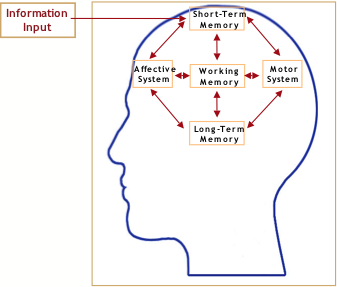
- Not as linear, things go both ways.
- Multidisciplinary notion of how the brain works.
- Learning is complex
- it requires situating things in what you already know
Principles of Learning from Cognitive Science
- Must clear up misconceptions, and connect with prior knowledge.
- Competence in an area of inquiry, requires a deep understanding of factual information. This gives you the broader framework to retrieve and apply the information.
- Learner is the important one! Metacognitive approach is essential. Learners control their own learning.
- teachers use what students know to help them understand the unknown
- teacher enhance learner competence by using conceptual framework and ways of organizing
- teachers use a metacognitive approach to help learners control their own learning

