Sunday, February 8, 2009

CORE UNDERSTANDING 9: Children develop phonemic awareness and knowledge of phonics through a variety of litearcy opportunities.

Debate over early literacy development centers on
  1. the place of phonemic awareness
  2. the place of phonics
Some research shows PA as an important factor in reading, while other research suggests PA and phonics are necessary but not sufficient for readers.

Policy decisions that influence education waiver with the definition of reading. Is it a process of decoding? or of making meaning? Those who think reading is making meaning feel that too much focus on the parts takes away attention needed for the whole. Those who see reading as decoding point to high performance on standardized tests (KB, 79).

A balance is needed.

Instruction in PA
Explicit instruction may be necessary for some students, but these are general, research based, instructional strategies:
  1. Language play: games for rhyming and thinking about structure of words.
  2. Sociodramatic play: thematic activities to expand integration and extend understanding of language and stories.
  3. Reading aloud: models what language sounds like and how one reads.
  4. Opportunities to help children notice and use letters and words: alphabets, word walls, visual aspects of print.
  5. Invented spelling: trying out spelling of words using phonemic awarenss and phonic knolwedge.
  6. Dictated Text: reading dictated text helps connect sound to grapheme.
  7. Reading for meaning
  8. Rich text experience
Phonics Instruction--incorporate with reading for meaning!

CORE UNDERSTANDING 8: Children's understandings of print are not the same as adults'

Concepts of Print
Adults understand that alphabetic principles govern written language. Children are unaware of this, instead the "perceive written language and provide evidence that they are aware that there is a message in that transaction when they read "break the car" in response to a stop sign or "toothpaste" in response to a Crest label" (Braunger & Lewis, 2006. p. 74).

Children must become aware of the meaning in written language.

Onset= consonants before a vowel in spoken syllable
Rimes= are the vowel and any consonants after the onset.

The Role of Phonemic Awareness in Learning to Read

Notes from "What research has to say about reading instruction" by Alan E. farstrup, S. Jay Samuels. (Ch 6 p. 110)
Phonemic Awareness (PA)

  • Is one of the leading predictors of how well chilren will learn to read upon school-entry.
  • Phonemes are the smallest units of spoken language. (English has 41-44)
  • Words most often consist of a blend of phonemes.
  • PA is the ability to focus on and manipulate sounds in spoken words.
PA Tasks
  1. Phoneme isolation--what is the first sound in "paste".
  2. Phoneme identity--"tell me the sound that is the same in bike, boy, and bell"
  3. Phoneme categorization--"which word doesn't belong? bus bun or rug"
  4. Phoneme blending-- What word is /s/ /k/ /u/ /l/? (school)
  5. Phoneme segmentation--how many sounds in ship? /sh/ /I/ /p/ (three)
  6. Phoneme deletion--"what is smile with out the /s/?" (mile)

Phonemes vs Graphemes
  1. Graphemes are letters or multiple letters (Ch, Sh, TH) that symbolize a phoneme.
Phonemes vs Phonics
  1. Phonics is the connection between phoneme and grapheme (letter) to spell or decode words.
  2. Phonological awareness is different still.
  • understanding of how phonemes can be used with rimes, onset, and syllables.
ELLs are likely to misperceive some English phonemes because their linguistic minds are programed to categorize phonemes in their first language.

PA and Learning to Read
English is an alphabetic language that connects phonemes to graphemes.
PA is important because new readers need PA to:
  • decode new words by blending phonemes
  • segment a word into phonemes to remember/spell individual words.
  • no breaks in speech signalling a new phoneme, so readers need instruction.
Teaching PA
  • Important for moving preschoolers and kindergarteners closer to reading.
  • PA instruction includes games, songs, and taks that ask students to isolate, segment, blend, delete and otherwise manipulate phonemes.
  • Shown to improve reading performance in first two years of school.
  • most effective for younger children.
  • connections with print help enhance literacy acquisition.
  • Segmenting and blending are especially important for reading

Monday, January 26, 2009

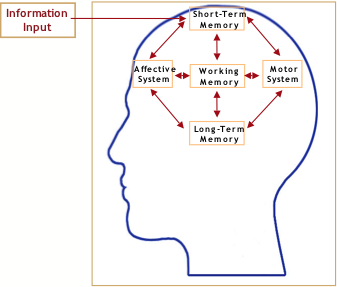
Information Processing: Stage Theory and what it means for teaching.


Stage Theory:
  1. Environmental input--from sensory registers (visual, auditory, haptic/tactile).
  2. Then your brain has to process those inputs
  3. And you have a response output/long-term store/permanent memory
  4. Information retrieved for use by the connections you have made to it.
Short term memory can have connections with speech/auditory even though it might be presented visually... you "say" letters in your head.

Implications:
Deep Learning requires understanding.
Good comprehension skills must be based in understanding.
Learning is based on connections.

Reading an Arabic text--helps you understand what its like to start reading for the first time.

Updating the Model

  • Not as linear, things go both ways.
  • Multidisciplinary notion of how the brain works.
  • Learning is complex
  • it requires situating things in what you already know


Principles of Learning from Cognitive Science
  1. Must clear up misconceptions, and connect with prior knowledge.
  2. Competence in an area of inquiry, requires a deep understanding of factual information. This gives you the broader framework to retrieve and apply the information.
  3. Learner is the important one! Metacognitive approach is essential. Learners control their own learning.
In Other Words.....
  • teachers use what students know to help them understand the unknown
  • teacher enhance learner competence by using conceptual framework and ways of organizing
  • teachers use a metacognitive approach to help learners control their own learning

Attributes of Learning and Teaching

Attributes of Learning
Brainstorm List:
  • Social
  • Interconnected
  • Motivation--intrinsic/extrinsic
  • Authentic
  • Embodied Aesthetic Wholeness (Learning is Living)
  • Building on Correct Understanding
  • Metacognitive
  • Learner Factors
  • Environment/Contextual Factors
Pat's List:
Active--observing and doing, dialoging with self and others
Intentional (mindful)--working toward real and meaningful goals
Reflective--monitoring, thinking about
Complex-- ill-structured, unpredictable, no simple formula for solution
Contextual--reflect real-world problems & tasks; authentic environments & cases
Conversational--alternate forms of communication used; discussing
Collaborative-- working together toward a common goal, profiting form each other's strengths
Responsible--buy in, create, maintain, take over on own.
Thoughtful--can't learn without thinking